Followers

Sunday, 21 March 2010

THE BIRD THAT BELONGS TO THE SONG...


Digital image creation and manipulation by Elaine Erig


.................................
frayed sunlight
between the pilings –
summer’s end
..................................
cornflowers —
between the clouds
a handful of sky
.................................
a rainbow
over autumn maples…
the laundry forgotten
..................................
drowsy morning…
the bird that belongs
to the song….
by Laryalee Fraser

Laryalee Fraser is a retired reporter/photographer, living in British Columbia. Writing poetry became part of the healing process after her husband's death in 2000, and she continues to enjoy the challenge, experimenting with digital art as an accompaniment to poems on her Web site. Gardening is another passion, giving her the chance to connect with nature while pondering those life questions that drift so close, yet always remain out of reach....

Saturday, 13 March 2010

Thursday, 18 February 2010

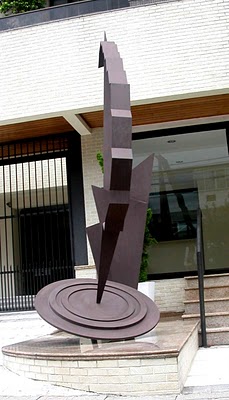
TO THE SUN - DIAL

STEEL SCULPTURE BY ELAINE ERIG


To The Sun-Dial

a poem by John Quincy Adams


To The Sun-Dial
(Under the Window of the Hall of the House
of Representatives of the United States)

To The Sun-Dial
Thou silent herald of Time's silent flight!
Say, could'st thou speak, what warning voice were thine?
Shade, who canst only show how others shine!
Dark, sullen witness of resplendent light
In day's broad glare, and when the noontide bright
Of laughing fortune sheds the ray divine,
Thy ready favors cheer us--but decline
The clouds of morning and the gloom of night.
Yet are thy counsels faithful, just, and wise;
They bid us seize the moments as they pass--
Snatch the retrieveless sunbeam as it flies,
Nor lose one sand of life's revolving glass--
Aspiring still, with energy sublime,
By virtuous deeds to give eternity to Time


Wednesday, 10 February 2010

VACATIONS IN FORENCE

 FOR 5 DAYS

Sunday, 24 January 2010

BETRAYING FINGERS


KIM HONG - TAE . Primitivesses + Child ´s Mind , mixed midia on canvas 41x53 cm

Mo Mo

BETRAYING FINGERS


At night I reach out my hands
Bright fingers, pointing
in the direction of roses, my head bent silently
to the blooming, withered
and soft fingers, pointing
in the direction of waves, my head bent silently
to the calm
cold fingers, pointing
in the direction of the cliff, my head bent silently
to those who remain
I slip into spring water pebbles cloves
My hair has grown like wheat, but can't be harvested

At night I reach out my hands
rough fingers pointing
in the direction of language, my head bent silently
to the talking, listening
and slim fingers, pointing
in the direction of a miracle, my head bent silently
to the existing, non-existing
and bent fingers, pointing
in the direction of a dream, my head bent silently
to the beautiful scenes and nightmares
At night, I dream I'm thrown into a slaughterhouse
Death is not a secret, death is a gaze

Dawn is here, the fingers are still pointing
in the direction of a song
Once I sang, but now I have lost my voice
The sun has risen, the firm fingers pointing
in the direction of mother
I was born there, but now I am drifting farther away
The sun is blinding my eyes, the trembling fingers
pointing in the direction of a city
which holds a funeral for me
as if I were a puppet

who doesn't show any sign of life unless touched by a hand
Tears stain my face, I can't see
what direction the last finger is pointing
If it's pointing in the direction of my imagination
then it's the direction of time
which is also your direction
After someone said the water was flowing so fast
you came over and made a whirlpool
to drown me, to choke me
then you pointed your finger suddenly
in the direction of the void

translated by Wang Ping and Lewis Warsh

Tuesday, 12 January 2010

R

k

Friday, 8 January 2010

DARK LIKE ME


Dream Variation

To fling my arms wide
In some place of the sun,
To whirl and to dance
Till the white day is done.
Then rest at cool evening
Beneath a tall tree
While night comes on gently,
Dark like me--
That is my dream!

To fling my arms wide
In the face of the sun,
Dance! Whirl! Whirl!
Till the quick day is done.
Rest at pale evening . . .
A tall, slim tree . . .
Night coming tenderly
Black like me.

 Langston Hughes

Wednesday, 23 December 2009

NEVER TRY TO TRICK ME WITH A KISS


Never try to trick me with a kiss
SYLVIA PLATH

Never try to trick me with a kiss
Pretending that the birds are here to stay;
The dying man will scoff and scorn at this.

A stone can masquerade where no heart is
And virgins rise where lustful Venus lay:
Never try to trick me with a kiss.

Our noble doctor claims the pain is his,
While stricken patients let him have his say;
The dying man will scoff and scorn at this.

Each virile bachelor dreads paralysis,
The old maid in the gable cries all day:
Never try to trick me with a kiss.

The suave eternal serpents promise bliss
To mortal children longing to be gay;
The dying man will scoff and scorn at this.

Sooner or later something goes amiss;
The singing birds pack up and fly away;
So never try to trick me with a kiss:
The dying man will scoff and scorn at this.

Saturday, 21 November 2009

WHEN YOU LOOK AT HIM YOU SEE DARK NIGTH


CATS...MEOW 100 POSTS

Black Horse with White Chest

Black hindquarters, white chest:
he flies on the wings of the wind.

When you look at him you see dark night
opening, giving way to dawn.

Sons of Shem and Ham live harmoniously
in him, and take no care for the words
of would-be troublemakers.

Men’s eyes light up when they see
reflected in his beauty

the clear strong black and white
of the eyes of beautiful women.

--Ibn Sa‘id al-Maghribi
1214-1274 Central Andalusia

Wednesday, 28 October 2009

ME PEACOCK


WHAT'S riches to him

That has made a great peacock
With the pride of his eye?
The wind-beaten,stone -grey,
And desolate
Three RockWould nourish his whim.
Live he or die
Amid wet rocks and heather,
His ghost will be gay
Adding feather to feather
For the pride of his eye.
WHAT'S riches to him
That has made a great peacock
With the pride of his eye?
The wind-beaten, stone-grey,
And desolate
Three RockWould nourish his whim.
Live he or die
Amid wet rocks and heather,
His ghost will be gay
Adding feather to feather
For the pride of his eye.
William Butler Yeats

Monday, 12 October 2009

RHAPSODY ON A WINDY NIGHT

marie-babey-cat-in-the-stairs


Rhapsody on a Windy Night
by T. S. Eliot

Twelve o'clock.
Along the reaches of the street
Held in a lunar synthesis,
Whispering lunar incantations
Dissolve the floors of memory
And all its clear relations,
Its divisions and precisions,
Every street lamp that I pass
Beats like a fatalistic drum,
And through the spaces of the dark
Midnight shakes the memory
As a madman shakes a dead geranium.

Half-past one,
The street lamp sputtered,
The street lamp muttered,
The street lamp said, "Regard that woman
Who hesitates towards you in the light of the door
Which opens on her like a grin.
You see the border of her dress
Is torn and stained with sand,
And you see the corner of her eye
Twists like a crooked pin."

The memory throws up high and dry
A crowd of twisted things;
A twisted branch upon the beach
Eaten smooth, and polished
As if the world gave up
The secret of its skeleton,
Stiff and white.
A broken spring in a factory yard,
Rust that clings to the form that the strength has left
Hard and curled and ready to snap.

Half-past two,
The street lamp said,
"Remark the cat which flattens itself in the gutter,
Slips out its tongue
And devours a morsel of rancid butter."
So the hand of a child, automatic,
Slipped out and pocketed a toy that was running along the quay.
I could see nothing behind that child's eye.
I have seen eyes in the street
Trying to peer through lighted shutters,
And a crab one afternoon in a pool,
An old crab with barnacles on his back,
Gripped the end of a stick which I held him.

Half-past three,
The lamp sputtered,
The lamp muttered in the dark.

The lamp hummed:
"Regard the moon,
La lune ne garde aucune rancune,
She winks a feeble eye,
She smiles into corners.
She smoothes the hair of the grass.
The moon has lost her memory.
A washed-out smallpox cracks her face,
Her hand twists a paper rose,
That smells of dust and old Cologne,
She is alone
With all the old nocturnal smells
That cross and cross across her brain."
The reminiscence comes
Of sunless dry geraniums
And dust in crevices,
Smells of chestnuts in the streets,
And female smells in shuttered rooms,
And cigarettes in corridors
And cocktail smells in bars."

The lamp said,
"Four o'clock,
Here is the number on the door.
Memory!
You have the key,
The little lamp spreads a ring on the stair,
Mount.
The bed is open; the tooth-brush hangs on the wall,
Put your shoes at the door, sleep, prepare for life."

The last twist of the knife.

Thursday, 8 October 2009

THE WORLD HARMONY RUN

My birthday song:


I plan to soar,
I plan to roar.
The bird in me
Will teach me how to soar.
The lion in me
Will teach me how to roar.
I plan to love,
Below, above.
The lover in me will teach me
How to love
Within,
Without,
Below, above.


Sri Chinmoy was born in India and came to the West in 1964. Sri Chinmoy lived in New York, until his Mahasamadhi in 2007.

Sri Chinmoy is a spiritual teacher who dedicated his life in the service of humanity. he endeavoured to inspire and serve mankind with his soulful offerings - his prayers and meditations, literary, musical and artistic works.

Saturday, 3 October 2009

ROB SEWARD

my current personism loves pictures like these


UmweltIII (HOME), 2007


Rob Seward's interests include the sublime,communication, and internal psychological exploration. He has lectured at the Centre Pompidou, Paris; the Chelsea Art Museum; and Location One, both in New York City. His work is widely exhibited in the US and Europe. He holds a master's from the Interactive Telecommunications Program (ITP) at New York University's .

Monday, 28 September 2009

DON'T GO FAR OFF, NOT EVEN FOR A DAY


DON'T GO FAR OFF, NOT EVEN FOR A DAY
Don't go far off, not even for a day, because --
because -- I don't know how to say it: a day is long
and I will be waiting for you, as in an empty station
when the trains are parked off somewhere else, asleep.

Don't leave me, even for an hour, because
then the little drops of anguish will all run together,
the smoke that roams looking for a home will drift
into me, choking my lost heart.

Oh, may your silhouette never dissolve on the beach;
may your eyelids never flutter into the empty distance.
Don't leave me for a second, my dearest,

because in that moment you'll have gone so far
I'll wander mazily over all the earth, asking,
Will you come back? Will you leave me here, dying?


Pablo Neruda was born in Parral, Chile. He studied in Santiago in the twenties. From 1927 to 1945 he was the Chilean consul in Rangoon, in Java, and then in Barcelona. He joined the Communist Party after the Second World War. Between 1970 and 1973 he served in Allende’s Chilean Government as ambassador to Paris. He died shortly after the coup that ended the Allende Government.

Monday, 21 September 2009

TO THE TUNE OF LIKE A DREAM


Hai Tian ,1951,Dongan county, Hunan province.
Member of Chinese Artists Association, deputy of the Traditional Chinese Painting Committee of Hunan Painter Association, vice chairman of the Hunan Gongbi Painting Association, Hunan branch and chairman of the Xiaoxiang Gongbi Painting Art Research Institute.
. The whole realm of artistic world lies open for him to explore. He often rebuilds his unique artistic "microcosms" from the universe through a demonstration of aesthetic manifold structure, which integrates national style with the modern sense, the concrete with the abstract, the void with the real and the philosophic idea with wild flavor. His works are unique and graceful, creating a deep and implicit world imbued with poetic and philosophic conceptions. Critics say that his works have a peculiar style of natural grace and make his master of a school. They also say that his paintings reveal poetic beauty and intelligence.
("A Collection of Works by One Hundred Outstanding Chinese Painters", "A Collection of Works by the Prize-winners in the Eighth National Paintings Exhibition", "A Collection of Ink-and-wash by the Greatest Chinese Painters in the World", and the "Gems of 20th Century Chinese Paintings". His artistic achievements were taken down in many large dictionaries in china and other countries such as "Dictionary of the World's Modern Artists". In 1997, he was elected as "One of the Hundred Chinese Most Outstanding Painters" by the Chinese Writers and Artists Association)
............................................................................................................................................................
Li Qingzhao : 李清照; : 李清照, Wade-Giles; Li Ch'ing-chao,pseudonym Yi'an Jushi (易安居士 “Yi'an HOUSEHOLDER (1084–c. 1151) was a Chinese writer andpoet of the Song Dynasty, regarded by many as the premier woman poet in the Chinese language citation needed.

To the Tune of Like a Dream

Last night a sprinkling of rain,
a violent wind.
After a deep sleep, still not recovered
from the lingering effect of wine,
I inquired of the one rolling up the screen;
But the answer came: "The cherry-apple blossoms
are still the same."
"Oh, don't you know, don't you know?
The red must be getting thin,
while the green is becoming plump."

Friday, 18 September 2009

THE RAINY DAY


The Rainy Day by Rabindranath Tagore


Sullen clouds are gathering fast over the black fringe
of the forest.
O child, do not go out!
The palm trees in a row by the lake are smiting their heads
against the dismal sky; the crows with their dragged wings are
silent on the tamarind branches, and the eastern bank of the river
is haunted by a deepening gloom.
Our cow is lowing loud, ties at the fence.
O child, wait here till I bring her into the stall.
Men have crowded into the flooded field to catch the fishes
as they escape from the overflowing ponds; the rain-water is
running in rills through the narrow lanes like a laughing boy who
has run away from his mother to tease her.
Listen, someone is shouting for the boatman at the ford.
O child, the daylight is dim, and the crossing at the ferry
is closed.
The sky seems to ride fast upon the madly rushing rain; the
water in the river is loud and impatient; women have hastened home
early from the Ganges with their filled pitchers.
The evening lamps must be made ready.
O child, do not go out!
The road to the market is desolate, the lane to the river is
slippery. The wind is roaring and struggling among the bamboo
branches like a wild beast tangled in a net.


Rabindranath Tagore , MAY 7 18651- AUGUST 7 1941,
BENGALI poet His name was originally written as Robindronath Thakur. He was also a philosopher and an artist. He also wrote many stories, novels and dramas. He also composed music and many songs. His writings greatly influenced Bengali culture during the late 19th century and early 20th century. In 1913, he won the Noble Prize for literature. He was the first Asian to win this prize. People also call him Gurudev.
Tagore was born in Calcutta). Tagore was a BENGALI BRAHMIN by birth. He wrote his first poem when he was only eight years old. Tagore's major works included Song Offerings, Gora (Fair-Faced), and Ghare-Baire (The Home and the World); and many other literary and art works. style.
Tagore wrote JANA GANA MANA the national anthem of India He also wrote AMAR SHONAR BANGLA the national anthem of BANGLADESH


Wednesday, 9 September 2009

Tuesday, 8 September 2009

Impersonation on Blogger

the Impersonation on BloggerAdd Image


If you are aware of someone you know being impersonated on us blog, CAT...MEOW or a TRASPIRARE IL POMERIGGI DI SOLE please LET US KNOW


WE FIND :"Atra Spirare il Pomriggiodis" and "Elaine Erig - Cats Meow" in blogs of friends,thank´s

Friday, 4 September 2009

MATA HARI


Mata Hari was the stage name of Margaretha Geertruida "Grietje" Zelle (7 August 1876, Leeuwarden – 15 October 1917, Vincennes), a Dutch-Frisian exotic dancer and courtesan who was executed by firing squad for espionage during World War I

"EYE OF THE DAY"

Thursday, 27 August 2009

POETS OF MONGOLIA

PETER KRÜGEL- SAKTHYA BYAMBA -PETER BROSENS


Poets of Mongolia evokes the meaning of poetry in the daily life of ordinary people who are trying to cope with harsh reality in a rapidly changing world. Through poetry a miner praises nature, a heating technician evokes man's destiny, a blind singer expresses her wish to see, and an expatriate finds the strength to survive in a foreign country.

Inti Films' Mongolia Trilogy (City of the Steppes, 1994, State of Dogs, 1998 -third part-Inti Films -)Mongolian State Award Best Documentary 1999

Wednesday, 19 August 2009

PROLOGUE TO AFRICAN CONSCIENCE


... Born in the highland village of Boda, near Ambo , west of the Ethiopian capital, Addis Ababa 17 August 1936 died in Manhattan on 26 February 2006.


Prologue to African Conscience


Tamed to bend
Into the model chairs
Carpentered for it
By the friendly pharos of its time
The black conscience flutters
Yet is taken in.


it looks right
It looks left
It forgets to look into its own self:
The broken yoke threatens to return
Only, this time
In the luring shape
Of luxury and golden chains
That frees the body
And enslaves the mind.
Into its head
The old dragon sun
Now breathes hot civilization
And the wise brains
Of the strong sons of the tribes
Pant
With an even more strange suffocation.

Its new self awareness
(In spite of its tribal ills)
Wishes to patchits torn spirits together:
Its past and present masters
(With their army of ghosts
That remained to haunt the earth)
Hook its innermost soul
And tear it apart:
And the african conscience
Still moans molested
Still remains drifting uprooted.

A lover love-rejected
With a spirit dejected,
A monk God-forsaken
hose total Faith is shaken,
Are less lost than dreamer
Into whose peace a “ question “
Plunged like a knife
And woke him to life,
To search, to find his way
To dodge, to fight his way
NOT dream it away !


On the grave of my friend, I stood.
For blood and flesh, I stayed . . .
And with faith I prayed, and prayed;
For blood and flesh, he was robed
. . .And with doubt, I hoped, and I hoped.
On the grave of my friend, as I stayed;
… On my future, I brood .

I stood on the grave of a man.
A tomb-stone of a man, I burdened.
The grave of a man, I murdered:
And with hope, my future, I sketched,
When with prayer, my killer hand, I stretched.
On the tomb-stone, of the man, I murdered:
. . Urrahh!!! I won!
On my victim’s carcass, I climb.
While on his tomb, I tread …
My bloody fingers, I spread:
Thus to repent, to justify, I have tried …
While I hoped, and prayed, I have cried.
And I won, my daily wine, and bread!
… Is it a crime?

I did not know, oh sir, that I stood on your way,
It all happened in chance; argument is unfit,
If we fight, others will benefit,
And as this road is also where my future lay,
Destiny forces me to answer you with “ Nay “
Pray lose no temper: lest you commit
A risk to result in a regrettable wit,
For, if there be crime, guilty is just the day:

I am also in yours as you are in my shoes
So do let us shift sir, to either side
However painful it becomes, we should, though
We realize that it isn’t much to lose
That in spite of us the way is wide
And that after all, someday, both of us go.


Showers of anguish
Rain, do not exhaust
Ocean of revenge
Of the innermost
Voice of the betrayed
Comfort of the lost,

Tears torn of self
Blood of the heart.<

Tuesday, 11 August 2009

ENGLISH RENAISSANCE

Edward de Vere, 17th earl of Oxford

[Who taught thee first to sigh?]

Who taught thee first to sigh, alas, my heart?
Who taught thy tongue the woeful words of plaint?
Who filled your eyes with tears of bitter smart?
Who gave thee grief, and made thy joys to faint?

Who first did paint with colors pale thy face?
Who first did break thy sleeps of quiet rest?
Above the rest in court who gave thee grace?
Who made thee strive, in honor to be best?

In constant truth to bide so firm and sure?
To scorn the world, regarding but thy friends?
With patient mind each passion to endure?
In one desire to settle to the end?

Love then thy choice, wherein such choice thou bind
As nought but death may ever change thy mind.

Were I a king

Were I a king I could command content ;
Were I obscure, unknown should be my cares;
And were I dead, no thoughts should me torment,
Nor words, nor wrongs, nor loves, nor hopes, nor fears.
A doubtful choice, of three things one to crave,
A kingdom, or a cottage, or a grave.


Edward de Vere, 17th earl of Oxford, born April 12, 1550, Castle Hedingham, Essex, Eng.died June 24, 1604, Newington, Middlesex
English lyric poet and patron of an acting company, Oxford's Men, who became, in the 20th century, the strongest candidate proposed (next to William Shakespeare himself) for the authorship of Shakespeare's plays.
Succeeding to the earldom as a minor in 1562, Oxford lived for eight years as a royal ward under the care of William Cecil (later Lord Burghley) and in December 1571 married Burghley's daughter, Anne Cecil. Along the way he studied at Queens' College and St. John's College, Cambridge. By the early 1580s his financial position had become very straitened, perhaps chiefly through his lack of financial sense. His younger children were provided for by Burghley, with whom he remained friendly even after Anne's death (June 1588) and his own remarriage in 1591 or 1592. In 1586 Queen Elizabeth granted him an annuity of £1,000.
He was never appointed to any important office or command, though he was named on the commissions of some noted trials of peers and was said to have been made a privy councilor by James I. It has therefore been suggested that the annuity may have been granted for his services in maintaining a company of actors (from 1580) and that the obscurity of his later life is to be explained by his immersion in literary pursuits. He was indeed a notable patron of writers. He employed
John Lyly, the author of the novel Euphues, as his secretary for many years.
That Oxford might be the author of Shakespeare's plays was first advanced in a major way in “Shakespeare” Identified in Edward de Vere, the Seventeenth Earl of Oxford (1920), a study by J. Thomas Looney. Looney argued that there was a biographical similarity between Oxford and both Bertram (in All's Well That Ends Well) and Hamlet and that Oxford's poems resembled Shakespeare's early work. Oxford's interest in the drama extended beyond noble patronage, for he himself wrote some plays, though there are no known examples extant. His 23 acknowledged poems were written in youth, and, because he was born in 1550, Looney proposed that they were the prelude to his mature work and that this began in 1593 with Venus and Adonis. This theory is supported by the coincidence that Oxford's poems apparently ceased just before Shakespeare's work began to appear. A further claim is that Oxford assumed a pseudonym in order to protect his family from the social stigma attached to the stage and also because extravagance had brought him into disrepute at court. A major difficulty in the Oxfordian theory, however, is his death date (1604), because, according to standard chronology, 14 of Shakespeare's plays, including many of the most important ones, were apparently written after that time. The debate, however, remained lively in the late 20th century.

Sunday, 9 August 2009

THE MANHATTAN PROJECT


Nagasaki (August 9, 1945)Events: Dawn of the Atomic Era, 1945
The next break in the weather over Japan was due to appear just three days after the attack on Hiroshima, to be followed by at least five more days of prohibitive weather. The plutonium bomb, nicknamed "Fat Man," was rushed into readiness to take advantage of this window. No further orders were required for the attack. Truman's order of July 25th had authorized the dropping of additional bombs as soon as they were ready. At 3:47 a.m. on August 9, 1945, a B-29 named Bock's Car lifted off from Tinian and headed toward the primary target: Kokura Arsenal, a massive collection of war industries adjacent to the city of Kokura.
The aircraft commander, Major Charles W. Sweeney, ordered the arming of the bomb only ten minutes after take-off so that the aircraft could be pressurized and climb above the lightning and squalls that menaced the flight all the way to Japan.


Nagasaki was an industrial center and major port on the western coast of Kyushu. As had happened at Hiroshima, the "all-clear" from an early morning air raid alert had long been given by the time the B-29 had begun its bombing run. A small conventional raid on Nagasaki on August 1st had resulted in a partial evacuation of the city, especially of school children. There were still almost 200,000 people in the city below the bomb when it exploded. The hurriedly-targeted weapon ended up detonating almost exactly between two of the principal targets in the city, the Mitsubishi Steel and Arms Works to the south, and the Mitsubishi-Urakami Torpedo Works (right) to the north. Had the bomb exploded farther south the residential and commercial heart of the city would have suffered much greater damage.
The explosion affected a total area of approximately 43 square miles. About 8.5 of those square miles were water, and 33 more square miles were only partially settled. Although the destruction at Nagasaki has generally received less worldwide attention than that at Hiroshima, it was extensive nonetheless. Almost everything up to half a mile from ground zero was completely destroyed, including even the earthquake-hardened concrete structures that had sometimes survived at comparable distances at Hiroshima. According to a Nagasaki Prefectural report "men and animals died almost instantly" within 1 kilometer (0.62 miles) of the point of detonation. Almost all homes within a mile and a half were destroyed, and dry, combustible materials such as paper instantly burst in
to flames as far away as 10,000 feet from ground zero. Of the 52,000 homes in Nagasaki, 14,000 were destroyed and 5,400 more seriously damaged. Only 12 percent of the homes escaped unscathed.
. A U.S. Navy officer who visited the city in mid-September reported that, even over a month after the attack, "a smell of death and corruption pervades the place." As at Hiroshima, the psychological effects of the attack were undoubtedly considerable.
As with the estimates of deaths at Hiroshima, it will never be known for certain how many people died as a result of the atomic attack on Nagasaki. The best estimate is 40,000 people died initially, with 60,000 more injured.
By January 1946, the number of deaths probablyapproached 70,000, with perhaps ultimately twice
that number dead total within five years.For those areas of Nagasaki affected by theexplosion, the death rate was comparable to that at Hiroshima.